


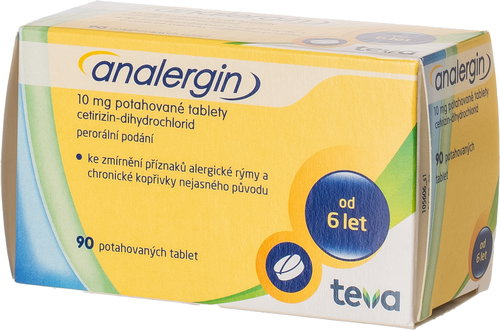
Analergin 10 mg 90 tablets

- Medication package insert
- Ingredient
- Specifications
- Photos & Videos 1
- Alternatives 8
- Accessories and suggested products

Analergin 10 mg 90 tablets

Registered medicinal product Analergin 10 mg
90 tablets, one coated tablet contains 10 mg cetirizine dihydrochloride
Analergine is a medicine that relieves the symptoms of allergic rhinitis and chronic
hives of unclear origin. The active substance is cetirizine dihydrochloride. Healing
Analergin is available in packs of 10, 30, 50 and 90 tablets. All
the packages listed are over-the-counter without a prescription. At the same time, it is possible
obtain a prescription for packs of 30, 50 and 90 tablets, these packs then have
partial reimbursement from the health insurance company.

The registered medicinal product Analergin 10 mg is indicated for the treatment of:
symptoms that are associated with allergic conditions
- hay fever
- persistent allergic rhinitis
- chronic urticaria
- relieve nasal and eye symptoms of seasonal and year-round allergic rhinitis
- relieve symptoms of chronic urticaria of unclear origin (chronic idiopathic urticaria)
Dosage and method of use
Children 6-12 years old: The recommended dose of the product is 5 mg (1/2 tablet) twice a day.
Adults and adolescents from 12 years of age: The recommended dose of the product is 10 mg (1 tablet)
once a day. In an allergic reaction, where the allergen meets the antibodies of our body, the
triggers a reaction and histamine is released. The released histamine acts
through binding to receptors in the body and through its effect on the so-called H1
receptors causes itching, swelling, dilation of blood vessels, narrowing of airways,
headaches, etc.
Cetirizine in Analergin and Levocetirizine in Analergin Neo are
antihistamines, which act by binding to H1 receptors, which are
are found in the body, mainly in blood vessels, smooth muscle and also on
nerve endings. These receptors "occupy" and prevent the binding of released
histamine to these receptors, thereby alleviating possible symptoms such as itching,
swelling and more.
Contraindications
The product is not intended for children under 6 years of age. The use of Ambrobene in pregnancy and during breastfeeding will be decided by your doctor. Read the package insert carefully.
Storage
Always keep the product out of sight and reach of children.
Do not take this product after the expiry date stated on the box and
blister for EXP. The expiry date shall be the last day of the month indicated.
Store at temperatures up to 25 °C in the original packaging to protect the product from
humidity.
Do not dispose of any medicines in wastewater or household waste.
Ask your pharmacist how to dispose of products you no longer use. This
measures help protect the environment.
Notice
Over-the-counter medicine. Read the full package leaflet carefully before taking this medicine. Analergine is a medicinal product for internal use. Contains the active ingredient cetirizine
dihydrochloride.

Allergies
An allergy is an exaggerated, disproportionate reaction of an individual's immune system to an otherwise
harmless substances, so-called. allergens commonly found in the environment. These
substances are well tolerated by the majority of the population, but not by an allergic person.
The body of the allergic person perceives these substances as dangerous and resists them. Due to the allergen
there is inadequate activation of antibodies specific for the allergic reaction -
immunoglobulin E (IgE) and these specific antibodies trigger an inflammatory immune
reaction - allergic inflammation. An increase in the amount of these antibodies in the blood is one
of the main evidence of allergy. The manifestations of allergy are very varied, starting with rhinitis,
sneezing, itchy eyes or skin, and possible anaphylactic shock.
The number of allergic patients is increasing worldwide. It is estimated that more than
1/3 of the population in the Czech Republic suffers from some type of allergy. Allergy is
genetically determined. It is reported that 60% of the population carries a congenital
predisposition to the development of allergic disease. However, the disease is usually
will only become apparent through the influence of the external environment. The first manifestations of allergy often occur as early as
in children, but its manifestations can occur at any age, or conversely
may not occur at all. The course of allergy is very individual. Many manifestations
Allergies can be treated effectively, and usually this treatment is long-term.
Causes of allergy
It seems that with the increasing level of civilization there are more and more allergy sufferers. In addition to genetics, there is
of the factors contributing to the development of allergies, pollution is considered to be the most important
environment, lifestyle (too much time in enclosed spaces,
lack of exercise in nature, excessive hygiene) and eating habits
(lack of vegetables, consumption of semi-finished products, etc.). A known risk
a factor is maternal smoking during pregnancy and after the birth of the child. Premature
inclusion of complementary foods in the infant's diet is also one of the important factors for
the development of food allergies.
Is allergy hereditary?
Allergic disease as such is not hereditary. With a genetic predisposition
we are born to develop allergies, but it is the encounter with the allergen that makes us allergic.
The hereditary tendency to develop allergies is called atopy. So it is not
about the disease. An atopic person is a person with a predisposition to allergies who tends to
to the production of IgE antibodies in response to even low doses of certain otherwise well
tolerated, external allergens. However, atopics may never develop allergies.
Knowing the prevalence of allergies in the family, we can determine the approximate risk of allergy
in children:
If neither parent is allergic, the risk of allergy in children is approximately 20%.
If one of the parents is allergic, the risk increases proportionally to 40%. If she is allergic
mother, the risk of transmitting an allergic disease to the child is about 4 times higher.
If both parents are allergic, the risk increases to 75-80%.
Manufacturer's address:
Teva Pharmaceuticals CR s. r. o., Sokolovská 136/A, 180 00 Prague
Specifications
Active ingredient
Category
Form
Usage
Packaging
Storage temperature
Identifiers
Pharmacotherapeutic group
Product characteristics

Teva Pharmaceuticals CR, s.r.o., Sokolovská 136/A, 180 00 Praha, CZ, +420548226521, [email protected] www.teva.cz
Specifications can be changed without notice. Images are for illustrative purposes only.