


Samson R10S
- Reviews 2
- Help and manuals
- Specifications
- Photos & Videos 1
- Alternatives 8
- Accessories and suggested products

Samson R10S
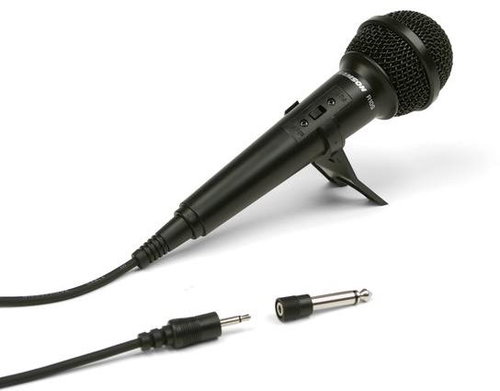
The Samson R10S dynamic microphone delivers great sound and versatility for a variety of recording and recreational audio applications. The microphone is ideal for karaoke, multimedia, portable recording and more. At the heart of the performance is a neodymium, multi-axis, shock-mounted microphone element. The capsule offers high gain and low impedance, and also has a cardioid pickup pattern. This allows the microphone to capture all the nuances of any performance with exceptional clarity and detail while reducing feedback and unwanted signals. The microphone offers a frequency response of 80Hz–12kHz, which is ideal for vocal and multimedia applications. The microphone is also equipped to withstand high sound pressure levels, producing vocals that sound powerful and crystal clear. It also features a convenient on/off switch and a hardwired microphone cable with a 1/8" connector. A 1/8" to 1/4" adapter and a desktop stand are included.

Handheld (for mount)
Microphone type
Dynamic
Microphone principle
Directional
Polar pattern
80–12,000Hz
Frequency range
Key Features of the Samson R10S Microphone
- Dynamic microphone
- Neodymium, multi-axis, shock-mounted microphone element
- Cardioid polar pattern
- High gain and low impedance
- Withstands high sound pressure levels
- Practical On/Off switch
- Hardwired 1/8" microphone cable
- 1/8" to 1/4" adapter and desktop stand included
- Ideal for karaoke, multimedia or portable recording

Suitable for home and portable audio, content creation, live sound, recording
Technical Specifications
- Transmission technology: analogue
- Polar pattern: cardioid
- Impedance: 500 Ohm
- Hardwired cable connector: 3.5mm Jack
- Compatibility: Android, iOS, Linux, macOS, Windows
Package Contents
- Samson R10S Microphone
- 1/8" to 1/4" adapter
- Desktop stand
 Microphone Principle
A dynamic microphone is suitable for open performances, live broadcasting, music production, etc. It uses a magnet and a moving coil to capture sound.
A condenser microphone is mainly used for studio purposes. It has higher sensitivity and lower noise. It must be powered separately.
 Frequency Range
The frequency range indicates the range of frequency values that the microphone records. The wider the range, the more sounds it can capture.
Low frequencies (e.g. 20–200Hz): Bass, the deepest notes of instruments (double bass, kick drum) and male voices.
Mid frequencies (e.g. 200–3,000Hz): The body of instruments, the foundation of the voice, where the ear is most sensitive, important for speech intelligibility.
High frequencies (e.g. 3,000–14,000Hz): Treble, details, sibilance and the 'sparkle' of the sound.
'Air' band (above 14,000Hz): Gives recordings a feeling of expensive, super-high-quality sound and space.
 Sensitivity
Microphone sensitivity is the ratio of output voltage to sound pressure. It expresses how loud a signal the microphone produces at a given sound pressure; higher sensitivity means a stronger voltage and is suitable for quiet studios, while lower sensitivity is better for noisy environments as it amplifies less unwanted ambient noise.
Specifications
Connection
Microphone characteristics
Features
Specifications can be changed without notice. Images are for illustrative purposes only.