


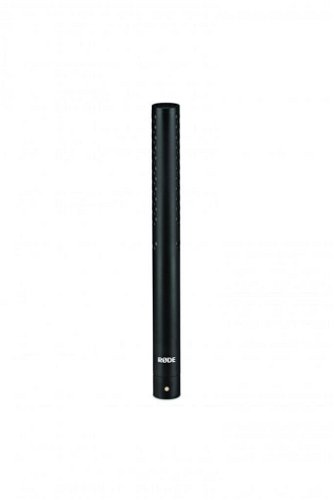
RODE NTG5
 Installment calculator
4,9%
interest
from 287,- monthly
Installment calculator
4,9%
interest
from 287,- monthly

RODE NTG5
The NTG5 is an ultra-lightweight professional shotgun microphone, ideal for use in the most demanding recording applications. Thanks to a revolutionary acoustic design, precisely controlled frequency response, smooth off-axis response and very low self-noise (only 10dBA), the NTG5 sounds great in a wide range of applications, especially location recording and filmmaking where superior sound is essential. The NTG5 features a revolutionary acoustic design unlike any other shotgun microphone. Instead of linear slots, it uses circular acoustic perforations, which provide greater acoustic transparency and a natural, uncoloured sound for excellent performance in a wide range of recording applications.

To the hot shoe
Microphone type
Condenser
Microphone principle
Highly directional
Directional characteristic
20–20,000Hz
Frequency range
Key Features of the RODE NTG5 Microphone
- Natural and uncoloured sound
- High acoustic transparency
- Precisely controlled frequency response
- Very low self-noise
- Highly directional supercardioid characteristic
- RF-bias technology for stable performance
- Resistant to adverse conditions
- Protective surface treatment
- Ideal for professional field recording
- Includes a complete location recording kit
- Supplied with accessories for professional use

Suitable for camera and video production
Revolutionary Design
The NTG5 has a short, very lightweight aluminium body, making it one of the most compact professional shotgun microphones. It's suitable for boom operators on long shoots, as well as filmmakers and sound engineers looking for a more portable and lightweight setup with amazing broadcast sound.


A Microphone for Recording in the Ideal Location
With its precisely controlled frequency response, low self-noise, highly directional supercardioid polar pattern, and smooth off-axis response, the NTG5 sounds great in a wide range of applications. It also boasts RF-bias technology and a conformal coating on the electronics, which protect the microphone from moisture and ensure incredible reliability even in harsh environmental conditions. The NTG5 is the perfect microphone for location recording and demanding film scenarios where superior sound is essential.
Technical Specifications
- Acoustic Principle: RF-bias condenser
- Active Electronics: RF-bias demodulation
- Polar Pattern: supercardioid shotgun
- Frequency Response: 80Hz–20kHz ±3dB
- Output Impedance: 25Ω
- Signal-to-Noise Ratio: 84dB
- Equivalent Noise: 10dB SPL (A-weighted, as per IEC651)
- Input SPL @ 1% THD: 130dB SPL (1kHz @ 1% THD, 600Ω load)
- Power Requirements: 2mA @ 48V phantom power
- Sensitivity: -23.5dB re. 1V/Pascal or better (66mV @ 94dB SPL @ 1kHz)
Package Contents
- 1× RODE NTG5 microphone
- 1× WS10 windshield
- 1× ZP1 medium padded zip pouch
- 1× PG2-R pistol grip shock mount
- 1× PG2-R Pro XLR Cable with Junction Box
 Microphone Type
Dynamic microphones are suitable for open performances, live broadcasting, music production, etc. They use a magnet and a moving coil to capture sound.
Condenser microphones are mainly used for studio purposes. They have higher sensitivity and lower noise. They require a separate power supply.
 Frequency Range
The frequency range indicates the span of frequency values that the microphone records. The wider the range, the more sounds it can capture.
Low frequencies (e.g., 20–200Hz): Bass, the deepest notes of instruments (double bass, kick drum) and male voices.
Mid frequencies (e.g., 200–3,000Hz): The body of instruments, the core of the voice where the ear is most sensitive, important for speech intelligibility.
High frequencies (e.g., 3,000–14,000Hz): Treble, details, sibilance, and the "shine" of the sound.
Air band (above 14,000Hz): Gives recordings a sense of expensive, super high-quality sound and space.
 Sensitivity
Microphone sensitivity is the ratio of the output voltage to the acoustic pressure. It expresses how loud a signal the microphone produces at a given acoustic pressure; higher sensitivity means a stronger voltage and is suitable for quiet studios, while lower sensitivity is better for noisy environments as it reduces the unnecessary amplification of ambient noise.
Specifications
Connection
Microphone characteristics
Power Supply
Features
Dimensions
Weight
Specifications can be changed without notice. Images are for illustrative purposes only.