


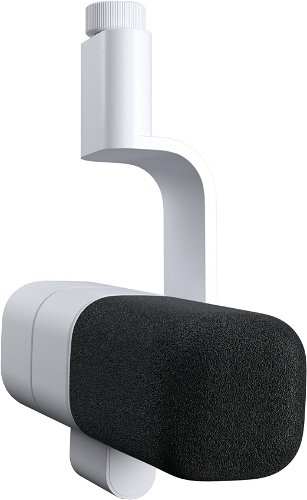
Logitech G Blue Yeti Studio, white
 Installment calculator
4,9%
interest
from 138,- monthly
Installment calculator
4,9%
interest
from 138,- monthly

Logitech G Blue Yeti Studio, white
The Logitech G Blue Yeti Studio is a desktop dynamic microphone designed for PC setups, streaming, gaming communication, and studio use. The design uses a professional XLR connection, a supercardioid directional pattern, and ClearAmp technology with an integrated active preamplifier. The frequency range of 40Hz to 18kHz is complemented by high resistance to loud sound sources and a design focused on clear voice reproduction. Its elegant finish expands the options for matching it with a modern gaming or work setup.

Desktop
Microphone type
Dynamic
Microphone principle
Highly directional
Directional characteristic
40–18,000Hz
Frequency range
Key Features of the Logitech G Blue Yeti Studio Gaming Microphone, White
- The Logitech G Blue Yeti Studio desktop dynamic microphone features supercardioid directional pickup
- Frequency range 40Hz–18kHz
- Integrated ClearAmp preamplifier
- Up to +25dB of additional gain
- Internal shock mount
- Low sensitivity to ambient noise
- 290° swivel mount
- Suitable for streaming and studio use

Suitable for PC, studio use, gaming communication and streaming

Sound Recording and Performance
The Logitech G Blue Yeti Studio microphone uses a dual-diaphragm dynamic capsule designed for clean and focused voice recording. The supercardioid directional pattern accentuates sound from the front and reduces pickup from the surrounding area. The 40Hz to 18kHz frequency range is optimised for spoken word, voice communication, and broadcast use. Sensitivity is -34dBV/Pa at 1kHz and the signal-to-noise ratio is 69.5dB A-wt. The maximum SPL is 129dB at 1% THD and 138dB at 5% THD.

ClearAmp and Construction
The integrated ClearAmp technology provides up to +25dB of additional gain directly within the microphone's body. This solution makes it easier to achieve a strong output signal without an external booster. The active preamplification helps when connecting to audio interfaces with lower input gain. The construction is designed for stable and clear voice transmission during both streaming and recording. ClearAmp technology expands the possibilities for use in both home and professional setups.

Construction and Controls
The internal shock mount isolates the capsule from mechanical vibrations caused by desk or mount movement. The integrated swivel mount allows for 290° of position adjustment. The Logitech G Blue Yeti Studio microphone can be precisely aimed according to your position or the layout of your workspace. The device's dimensions are 165 × 67 × 185mm. The microphone weighs 615g.

Software and Compatibility
The Blue Yeti Studio model uses a professional XLR interface for connecting to an audio interface or external mixing desk. The microphone supports +24V or +48V phantom power. An XLR cable and audio interface are not included in the package. The design is suitable for streamers, content creators, podcasters, and studio recording.
Technical Specifications
- Connection: XLR
- Sensitivity: -34dBV/Pa at 1kHz
- Signal-to-noise ratio: 69.5dB A-wt
- THD: 0.05% at 1kHz / 94dBSPL
- Maximum SPL: 129dB at 1% THD / 138dB at 5% THD
- Additional gain: up to +25dB
- Power: +24V or +48V phantom power
- Swivel mount range: 290°
- Dimensions: 165 × 67 × 185mm
- Weight: 615g
- Colour: white
Package Contents
- Logitech G Blue Yeti Studio microphone
- Additional windscreen
- 3/8” stand adapter
- Quick Start Guide
 Microphone Type
A dynamic microphone is suitable for live performances, live broadcasts, music production, etc. It uses a magnet and a moving coil to capture sound.
A condenser microphone is mainly used for studio purposes. It has higher sensitivity and lower noise. It requires its own power supply.
 Frequency Range
The frequency range indicates the span of frequency values that the microphone records. The wider the range, the more sounds it can capture.
Low frequencies (e.g. 20–200Hz): Bass, the deepest tones of instruments (double bass, kick drum) and male voices.
Mid frequencies (e.g. 200–3,000Hz): The body of instruments, the core of the voice where the ear is most sensitive, important for speech intelligibility.
High frequencies (e.g. 3,000–14,000Hz): Treble, details, sibilance and the "shine" of the sound.
Air band (above 14,000Hz): Gives recordings a sense of expensive, super high-quality sound and space.
 Sensitivity
Microphone sensitivity is the ratio of output voltage to acoustic pressure. It expresses how loud a signal the microphone produces at a given acoustic pressure; higher sensitivity means a stronger voltage and is suitable for quiet studios, while lower sensitivity is better for noisy environments as it doesn't unnecessarily amplify ambient noise.
Specifications
Connection
Microphone characteristics
Power Supply
Features
Dimensions
Weight
Parameter Logitech icon

With an annual turnover of $1.8 billion, Logitech is the world's largest manufacturer of computer peripherals and accessories. Its products include computer mice, keyboards, wireless communication devices - virtually anything. The company has over 7,200 employees and is based in Palo Alto.
Specifications can be changed without notice. Images are for illustrative purposes only.