


Dobrý den chci se zeptat když připojim mikrofon do redukce USB C lighting do mobilu iPhone tak bude to fungovat v GarageBand?

 Installment calculator
from
518,-
monthly
Installment calculator
from
518,-
monthly

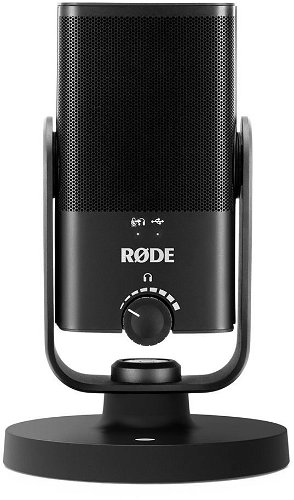
The RODE NT-USB Mini microphone is perfect for streamers, musicians, and PC gamers who need a high-quality microphone. The cardioid microphone precisely focuses on your voice and suppresses ambient sounds. The RODE NT-USB Mini was designed specifically to accurately capture monologues, dialogues, vocals, and musical instruments. The RODE microphone features a pop filter and a USB-C port for connecting to a computer. You can record audio using the jack connector. The magnetic stand reduces shocks and can be rotated 360 degrees. Additionally, RODE offers a studio-grade headphone amplifier that allows you to eliminate distracting echo in your recordings.


The NT-USB Mini brings the pristine sound quality of RØDE's world-renowned studio mics to a compact USB platform. It has been specifically designed to give recordings warmth and presence, and will sound amazing on dialogue, vocals, guitar—anything you throw in front of it. It features a studio-quality headphone amplifier and a high-quality 3.5mm headphone output, complete with precision volume control, allowing you to easily monitor your audio.

If you want to use the RODE NT-USB Mini microphone for podcasting, you will undoubtedly appreciate the RODE Connect app. This is a software solution ideal for podcasting and live streaming. In the app, you will have access to the built-in compressor, noise gate, and the APHEX Aural Exciter and Big Bottom processors. The RODE Connect app provides an intuitive and fully featured recording interface, virtual channels for connecting other guests, and automatic mix-minus on every channel. However, streamers and gamers will also find it useful, with quick options for customising their sound.

The NT-USB Mini has been designed to be as flexible as possible. It features a unique detachable magnetic desk stand, which not only provides a sturdy base on any desk but also makes it incredibly easy to remove and attach to a mic stand or studio arm. The unique 360-degree swing mount means you can position the mic upright, on an angle, sideways, or upside down—wherever it needs to be to get the best recording possible. Whether you're streaming on Twitch, recording in your favourite DAW, or taking a business call on Zoom, the NT-USB Mini will ensure you're heard in full definition.

Connect up to four NT-USB Minis to a single Mac or PC without the need for complex routing or complicated software. With its intuitive, fully featured recording interface, virtual channels for connecting remote guests, and automatic mix-minus on every channel for crystal-clear, echo-free communication, it’s the easiest way to make a professional podcast. Paired with the NT-USB Mini, RØDE Connect is a powerful solution for streamers and gamers who want to simplify their audio setup. Offering streamlined control over microphone and external application audio, plus dedicated output controls for streaming apps like OBS or Xsplit, setting up livestream audio has never been easier.
RØDE Central is the essential companion app for compatible devices from the RØDE range of wireless and classic microphones. It allows you to configure device settings, unlock advanced features, optimise and export recordings, access device information, and update to the latest firmware. Download it for free to fully unlock your device's potential. If you connect your RODE NT-USB Mini to your PC via USB, you can update the firmware through the RODE Central app. The app will then prompt you to allow the microphone's firmware update. This solution is not available for the RODE Central mobile app.
 Microphone principle
Dynamic microphones are suitable for open performances, live broadcasting, music production, etc. They use a magnet and a moving coil to capture sound.
Condenser microphones are mainly used for studio purposes. They have higher sensitivity and lower noise. They must be powered separately.
 Frequency range
The frequency range indicates the range of frequency values that the microphone records. The wider the range, the more sounds it can record.
Low frequencies (e.g. 20–200Hz): Bass, the deepest notes of instruments (double bass, kick drum) and male voices.
Mid-range frequencies (e.g. 200–3,000Hz): The body of instruments, the foundation of the voice, where the ear is most sensitive, important for speech intelligibility.
High frequencies (e.g. 3,000–14,000Hz): Treble, details, sibilance and the "shine" of the sound.
Air band (above 14,000Hz): Gives recordings a sense of expensive, super-high-quality sound and space.
 Sensitivity
Microphone sensitivity is the ratio of output voltage to acoustic pressure. It expresses how loud a signal the microphone produces at a given acoustic pressure; higher sensitivity means a stronger voltage and is suitable for quiet studios, while lower sensitivity is better for noisy environments as it is less likely to unnecessarily amplify ambient noise.
Specifications can be changed without notice. Images are for illustrative purposes only.